Dew point in plain words
Air carries water as invisible vapour. The dew point is the temperature to which that air must be cooled to become saturated (NOAA's definition). Any surface colder than the dew point of the air touching it collects water, exactly like a glass of iced water on a terrace table. The warmer and wetter the air, the higher its dew point, and the more surfaces in a building fall below it.
Two examples, calculated from temperature and relative humidity. A bedroom at 24 °C and 55 % has a dew point of about 14 °C. The air in a ceiling void at 30 °C and 70 % has a dew point of about 24 °C. Bare metal at 18 °C stays dry in the first air and drips in the second, unless insulation with a sealed vapour barrier keeps that air away from it.
Bali air: a high dew point all year
Over 2015 to 2024 the monthly mean dew point at Ngurah Rai ranged from 22.4 °C in August to 24.6 °C in March and April, with a yearly average near 24 °C (NOAA daily station data). For design, ASHRAE gives 26.9 °C as the dew point exceeded in only 0.4 % of the hours of a year. Weather Spark puts Denpasar air in its muggy-or-worse band, a dew point above about 18 °C, roughly 99 % of the time in every month. There is no dry season for a cold duct.
| Condition at Ngurah Rai | Air temperature | Dew point | Source |
|---|---|---|---|
| Most humid months, mean (March, April) | 28.3 to 28.4 °C | 24.6 °C | NOAA 2015-2024 |
| Least humid month, mean (August) | 26.5 °C | 22.4 °C | NOAA 2015-2024 |
| Whole year, mean | 27.7 °C | 23.9 °C | NOAA 2015-2024 |
| Most humid hours of the year (0.4 %) | 29.8 °C | 26.9 °C | ASHRAE 2021 |
NOAA Global Summary of the Day, station 97230, daily means averaged by month; ASHRAE dehumidification design condition with its mean coincident dry bulb.
Where the water shows up
The rule is simple: anything that runs colder than the dew point of the air around it will sweat once that air reaches it. In an air-conditioned building in Bali the list is longer than most owners expect.
| Surface | Why it runs cold | What you see |
|---|---|---|
| Supply ducts and plenums | They carry air straight from the cooling coil | Drips along the duct route, stained tiles, rust at hangers |
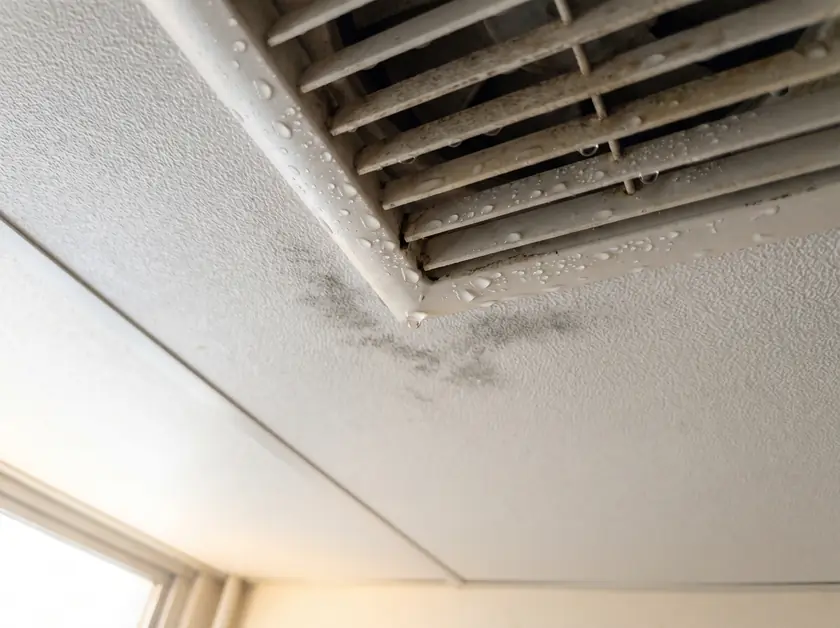
| Diffusers and grilles | Cold air leaves here and meets room or void air | Drops on the blades, dark spots around the diffuser |
| Refrigerant and chilled-water pipes | The larger (suction) pipe of a split, and chilled water in bigger buildings, run colder than anything else | Wet insulation, drips at clamps and hangers |
| Condensate drain lines | They carry cold water from the coil | A wet ceiling under the drain route, not under the unit |
| Ceiling above an air-conditioned room | Cooled from below, humid void or roof air above | Stains and mould on top of the board, sagging gypsum |
Each of these becomes a condensation point as soon as its surface temperature drops below the dew point of the air that reaches it.
The last row surprises people who know cold climates. There, moisture moves from the warm inside to the cold outside. In Bali it runs the other way: the humid outdoor air is the warm side and the air-conditioned room is the cold side, so vapour moves inwards and condenses on the first surface below its dew point, often the top of a ceiling or the back of a wall finish. That is why vapour barriers here belong on the outer, humid side of the insulation.
Cause 1: insulation without a vapour barrier
Insulation slows heat, but it does not necessarily stop vapour. Open-cell foam and glass wool without a sealed facing let humid air reach the cold metal behind them. The water then forms inside the insulation, which gets wet, stops insulating and drips. The usual failure points are joints that were never glued, gaps at hangers and clamps where the pipe touches the support, insulation stopped short at valves and flexible connections, and facings torn during later work in the ceiling.
For cold pipes we specify closed-cell elastomeric insulation with every joint and seam glued, and insulated supports so the pipe never touches bare metal. For ducts, a continuous vapour-sealed facing with taped seams. The thickness is checked for condensation, not only for energy: the outer surface must stay above the dew point of the surrounding air, using the manufacturer's condensation data for the site's temperature and humidity. An energy-code minimum answers a different question.
Send photos of the stains, the duct or pipe route above them and the AC units. We tell you what to measure first, before anyone opens the ceiling.
Cause 2: fresh air that brings the water in
Outdoor air at a 24 °C dew point holds about 19 g of water per kilogram; a room at 24 °C and 55 % holds about 10 g. At ASHRAE's design condition the outdoor figure is 22.6 g. So every 100 m³/h of untreated fresh air brings in about 1 litre an hour more water than the room air holds on an average day (100 m³/h × 1.2 kg/m³ × 8.6 g), and about 1.5 litres on the most humid days.
Problems start when that air goes where nobody planned it: an opening from the ceiling void to the outside, a fresh-air duct dumped into a return plenum, a terrace door open all evening. The humid air meets the cold ducts in the void, and the drips appear metres away from the unit. Fresh air that is cooled and dried first, or passed through an energy-recovery unit, arrives with much less water; see our note on villa humidity and heat recovery.
Cause 3: an oversized air conditioner
A unit that is too big for the room reaches the set temperature in minutes, then cycles off or throttles down. The coil spends little time cold enough to condense water, and when the compressor stops with the fan still running, water on the fins can evaporate back into the room. The room is cool but clammy, and damp surfaces, a stale smell and mould behind furniture follow. It is a common complaint in apart-hotel units that stay closed all day; we cover system choices in air conditioning for apart-hotels.
The fix is capacity from a load calculation that includes moisture, and settings that let the coil work: no fan running with the compressor off, dry mode where the unit has one, and fresh air that arrives already treated.
How an audit finds the source
- Map where and when the water appears: time of day, weather, which rooms, which AC mode.
- Measure the air: temperature and relative humidity in the room, in the ceiling void and outdoors, and calculate the dew point of each.
- Measure the surfaces: ducts, pipes, diffusers and the ceiling, with a contact probe or an infrared thermometer. Any surface below the dew point of the air around it is a condensation point.
- Log humidity for several days with small data loggers, because one visit may catch a dry afternoon.
- Open the insulation at suspect points (joints, hangers, valves) and check the condensate drains for slope, traps and blockages.
- Follow the air: where fresh air enters, whether the void is open to outside, how often the AC cycles.
Measuring first matters because the obvious fix is often the wrong one: a bigger AC unit in a damp room adds more cold surfaces. The MEP audit gives you the cause in writing, with options from the smallest fix up.
Fixes that keep surfaces dry, cheapest first
| Fix | Cost level | Solves |
|---|---|---|
| Clear and re-slope condensate drains, add traps, insulate drain lines | Low | Drips under the drain route, overflowing trays |
| Change AC settings: no fan-only running, dry mode, a sensible set point | Low | Clammy rooms, water evaporating back from the coil |
| Reseal insulation joints, insulate hangers and valves, replace wet sections | Low to medium | Local drips on pipes and ducts |
| Close openings between the ceiling void and outdoors | Medium | Humid void air on cold ducts and ceilings |
| Treat the fresh air through the AC coil or an energy-recovery unit | Medium to high | Moisture carried in by ventilation |
| Replace oversized units after a load calculation | High | Short cycling and high indoor humidity |
| Re-insulate whole runs or move ducts inside the conditioned space | High, structural | Sweating along the whole duct network |
The cheap fixes are also the first checks. Structural work comes only after measurements show it is needed.
Mould is the consequence, not the cause. Cleaning it without removing the cold surface or the humid air brings it back after the next rainy season. After a fix we measure surface temperatures against the dew point again. In new buildings we avoid the problem at design stage: ventilation and air conditioning with vapour-sealed insulation, drained condensate and treated fresh air, drawn in one model and checked at commissioning.