The expensive decisions are made when the lease is signed, when the kitchen is drawn and when the ceiling is closed. After that, every fix costs demolition, downtime or both. The checklist below follows the order in which decisions become expensive to change.
Stage 1. Choosing the site
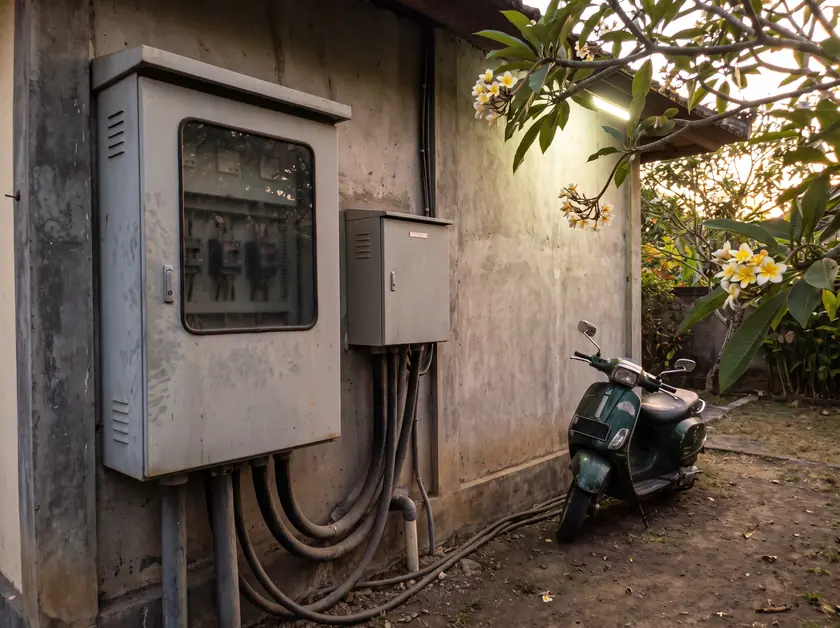
- Power. Read the PLN meter: connected VA and whether the supply is three-phase. A business connection from 6,600 VA to 200 kVA is on the B-2 tariff (Rp 1,444.70 per kWh in July to September 2026); above 200 kVA the venue moves to medium-voltage B-3 supply, which is a different project.
- Upgrade cost. The PLN connection fee under Permen ESDM 27/2017 is Rp 969 per VA up to 100 kVA and Rp 775 per VA from 100 to 200 kVA, before cables and boards on your side. A new 66 kVA connection is about Rp 64 million in fees alone.
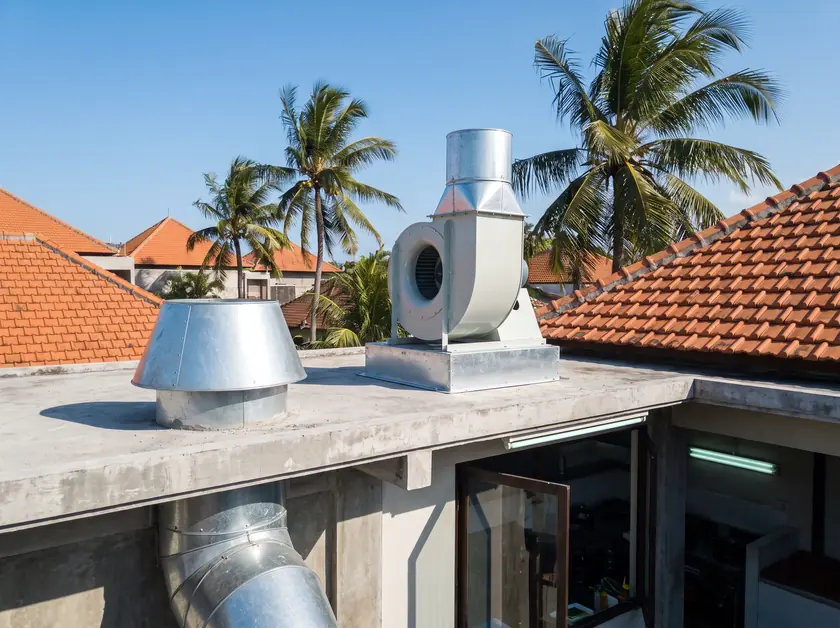
- Exhaust route. Find a physical path from the hood position to open air above the roof for a duct around half a metre across, plus a place for the fan. No route means moving the kitchen or discharging where guests and neighbours will smell it.
- Neighbours. Note villas, hotel rooms and windows near the likely fan and discharge; smell and fan noise both travel.
- Water. Source (PDAM mains, well or trucked), pressure, room for storage tanks and pumps, and a water test before the coffee machine and the combi oven are chosen.
- Drainage. Where wastewater goes, floor levels for slope, and a grease trap position a cleaning crew can reach without opening the kitchen floor.
- Gas and outdoor units. A ventilated place outside the kitchen for LPG cylinders, and shaded, serviceable space for AC outdoor units.
Stage 2. Concept and design
- Equipment list first: every appliance with its power in kW, phase, gas, water and drain needs. It is the base document for all systems.
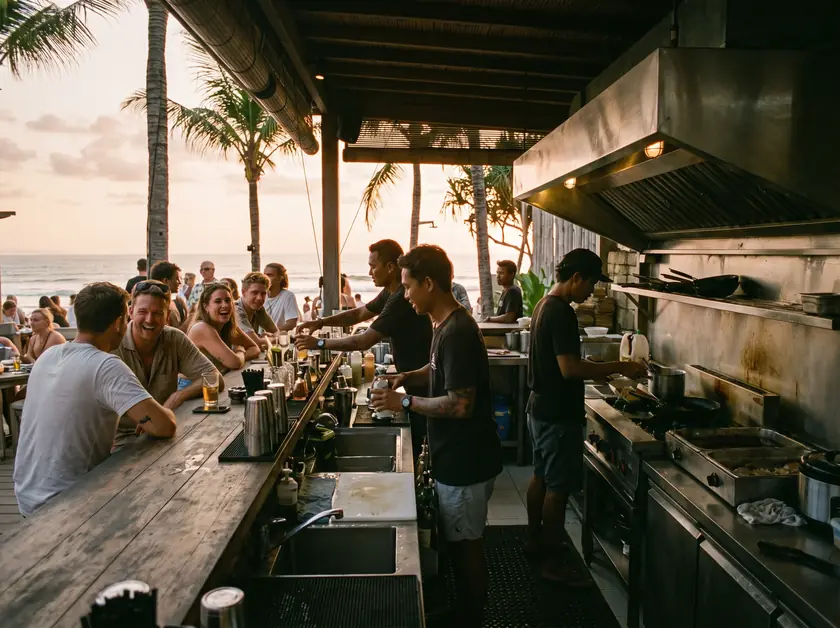
- Exhaust and make-up air per hood from its type, length and cooking duty (the exhaust calculator gives a first figure), with local make-up air below about 60% of the exhaust and the rest planned as transfer air; see kitchen air balance.
- Dining cooling from a load calculation: guests, sun, lighting and the outdoor air the dining room must supply, including the air it passes to the kitchen.
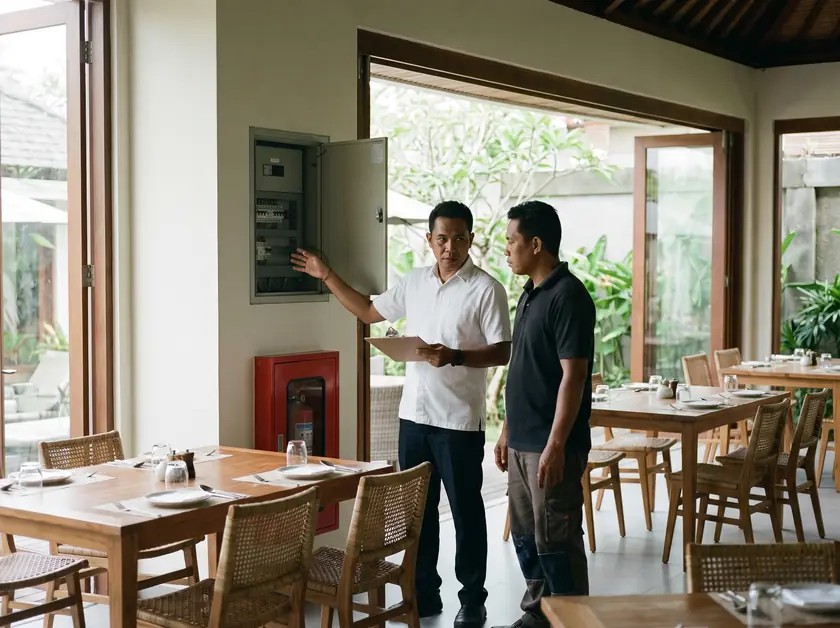
- Electrical load list with demand, phase balance and spare capacity, and only then the PLN connection size; see restaurant power in kVA.
- Water and hot water sized for the peak: dishwasher, pre-rinse, hand sinks and staff showers at the same time.
- Grease trap sized from the fixtures that drain into it and placed where it can be cleaned.
- Water treatment per machine: coffee machines, combi ovens, dishwashers and ice makers need different treatment.
- Gas: pipe route, shut-off valves and their link with the hood controls.
- Standards: Indonesia now has a dedicated standard for kitchen ventilation design, SNI 6572-5:2025 (Bagian 5: Dapur komersial); ask how the design addresses it.
Stage 3. Coordination in one model
Exhaust ducts, AC pipes, water lines, drains with their slope and cable trays all compete for the same ceiling. Drawn separately, they meet on site, where someone improvises a bend and the airflow drops. We draw them in one Revit model, resolve the clashes on screen and take the quantities for the estimate from the same model.
We have worked in Bali since 2024, and our key engineers bring more than 15 years of MEP practice. We design in Revit, install all systems with our own team and commission every mode. Our Bali work includes ventilation and stainless interior structures for Optimist and Kala restaurants.
Stage 4. Procurement
- Fans selected at the design airflow and the real system pressure, not by motor size.
- Hoods made to the drawings: length, overhang, filters, grease gutter and cleaning access.
- Kitchen equipment voltages and phases that match the board design.
- AC units chosen from the load calculation, with fresh air included.
- Stainless grades and outdoor finishes suited to salty air on coastal sites.
- Filters, cartridges and spare parts for the first months of service.
Send the address and photos of the PLN meter, the roof and the planned kitchen area. A free survey is available on request, so you know what the building can carry before you sign.
Stage 5. Installation
- Install in order: ducts and gravity drains first, because they need height and slope, then pressure pipes, then cable trays.
- Access doors along grease ducts, so the whole run can be cleaned.
- Photos of every ceiling and wall before it is closed.
- Every change marked on the drawings as it happens, for the as-built set.
- Labels on boards, circuits, valves and dampers.
Stage 6. Commissioning at full load
- Every cooking appliance hot, the dining room air conditioning in its normal mode.
- Exhaust and make-up airflows measured and set, pressure direction checked at the pass and the doors, hood capture checked with smoke.
- Electrical loads measured per phase at peak and protection settings checked.
- Water pressure at peak draw, hot water recovery, and drains running while the dishwasher empties.
- Interlocks and night mode tested, results and settings written down.
This is where a design is proven: the open kitchen does not smoke, the dining room does not smell and the equipment stays stable at peak hours.
Stage 7. Technical documents for SLF
Under PP 16/2021, the technical assessment of a building covers ventilation and air conditioning, lighting, clean water, wastewater and rainwater, the electrical installation, fire and lightning protection, and indoor temperature, humidity and air movement. Assessors measure with instruments, compare what is built with the technical plans and as-built drawings, and may add testing and commissioning. The technical pack for the MEP side:
- As-built drawings for every MEP system.
- Equipment schedules and data sheets.
- Commissioning results: airflows, electrical tests, water pressure.
- A water quality test.
- Operation and maintenance instructions.
Our MEP handover checklist for SLF goes through each item.
Stage 8. After opening: grease, dust and loads
- Hood filters cleaned on a fixed routine set by the menu.
- The exhaust system inspected for grease build-up: NFPA 96 sets monthly inspection for solid-fuel cooking, quarterly for high-volume cooking such as charbroiling or woks, and twice a year for moderate volume.
- Grease trap emptied on a schedule set from its size and the kitchen's volume.
- AC filters, coils and condensate drains serviced; water treatment cartridges changed.
- Electrical loads rechecked whenever equipment is added.
- Energy watched: ENERGY STAR puts restaurant energy use per square foot at about five to seven times that of other commercial buildings, and on B-2 every kWh costs Rp 1,444.70.
After launch we take the systems on planned maintenance, with the schedule set at commissioning.
Decisions that get expensive when made late
| Decision | When to make it | Cost of getting it late |
|---|---|---|
| PLN capacity and phases | Before signing the lease | Upgrade fee per VA plus new cables and boards, a delay before full service, or a menu cut to fit the supply |
| Exhaust duct route to the roof | Before signing the lease | Kitchen moved, or smells for guests and neighbours |
| Hood type and length for the menu | Concept design | Smoke at the hood ends; a new hood and often a new fan |
| Make-up and transfer air plan | Concept design | Whistling doors and smells in the dining room; ducts cut into a finished ceiling |
| Dining AC with fresh air | Design | Units added after complaints; a sticky, stuffy room |
| Grease trap size and position | Design | Floor opened to move it; blocked drains during service |
| Water treatment per machine | Before equipment is connected | Scaled boilers and steam generators, early repairs |
| Spare electrical capacity | Design | Rewiring when the second fryer or the bar arrives |
| All systems in one model | Before ordering | Clashes solved on site: lower ceilings, extra bends, lost airflow |
| Commissioning at full load | Before opening | Problems found by guests on opening night |
Indicative budgets: kitchen exhaust Rp 10–25 million for a small café line and Rp 25–60 million for a mid-size restaurant; a grease trap Rp 1.8–9 million.
Oversizing is not free either. On B-2, PLN applies a minimum monthly bill of 40 hours × connected kVA × the energy rate, so a 66 kVA connection costs at least about Rp 3.8 million a month, even in a quiet month. Spare capacity is planned from the load list, not guessed.
- PT PLN (Persero): Penetapan Penyesuaian Tarif Tenaga Listrik (Tariff Adjustment), Juli-September 2026
- Peraturan Menteri ESDM No. 27 Tahun 2017: service quality and connection fees of PT PLN (Lampiran I)
- Peraturan Pemerintah No. 16 Tahun 2021 on the implementation of the Buildings Law (JDIH BPK)
- Village of New Paltz: Kitchen hood cleaning requirements, summary of NFPA 96-2017 table 11.4
- ENERGY STAR: Restaurants, energy use per square foot
- BSN: SNI 6572-5:2025, Tata cara perancangan sistem ventilasi pada bangunan gedung, Bagian 5: Dapur komersial