Why closed bedrooms get stale and damp
A villa bedroom with the air conditioning on is a sealed box for eight or ten hours. Two people breathe out carbon dioxide and water vapour all night, and the bathroom next door adds steam from the shower. A wall split cools and recirculates the room air; it takes some water out on its coil, but it brings in no fresh air at all. By morning the air is stale, and in rooms where the AC cycles off at a comfortable temperature the humidity climbs as well.
Over months it turns into the complaints owners and guests know: a musty smell in wardrobes, towels that never dry, mould on the back of curtains and behind headboards. Mould is the consequence. The cause is air that is never replaced and moisture that has nowhere to go.
Why opening the window does not help
In a temperate climate you air a room by opening a window. In Bali the outdoor air is where the moisture comes from. At Ngurah Rai the average night-time low over 2015 to 2024 was about 25 °C, with monthly mean dew points of 22.4 to 24.6 °C (NOAA daily data). That night air is barely warmer than a 24 °C bedroom, but at a 24 °C dew point it carries about 19 g of water per kilogram, against about 10 g in a room at 24 °C and 55 % relative humidity.
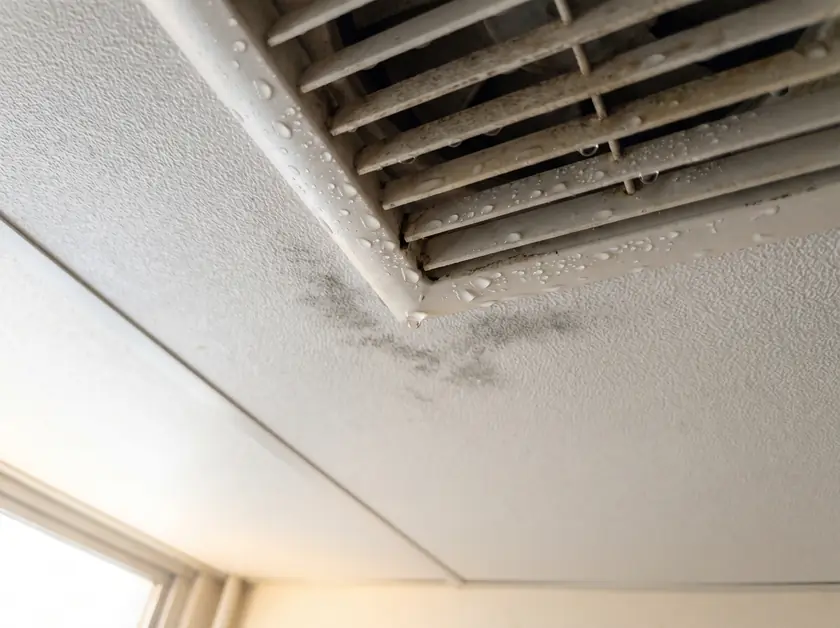
So an open window at night lets in air that is almost as cool as the room and nearly twice as wet. The AC then has to condense that water out, and cold surfaces nearby, from the diffuser to the glass, may start to sweat; see condensation on ducts and ceilings.
HRV or ERV: the moisture is the point
Both kinds of unit supply outdoor air, extract the same amount of stale air and pass the two streams through an exchanger. A heat recovery ventilator (HRV) moves only heat. An energy recovery ventilator (ERV) also moves water vapour from the incoming stream to the outgoing one, through a vapour-permeable membrane or a desiccant-coated wheel (ASHRAE Handbook, HVAC Systems and Equipment, 2020, chapter 26).
| Exchanger | Sensible (heat) | Latent (moisture) | Exhaust air carried over |
|---|---|---|---|
| Fixed plate (HRV) | 50 to 75 % | 0 | 0 to 2 % |
| Membrane plate (ERV) | 55 to 75 % | 25 to 60 % | 0 to 5 % |
| Energy wheel (ERV) | 65 to 80 % | 50 to 80 % | 0.5 to 10 % |
| Heat wheel (HRV) | 65 to 80 % | 0 | 0.5 to 10 % |
Typical effectiveness at equal airflows: 2020 ASHRAE Handbook, HVAC Systems and Equipment, ch. 26, Table 3. The last column is the exhaust air transfer ratio (EATR).
The Bali numbers explain the choice. At night the outdoor air is only slightly warmer than the bedroom, so heat recovery alone has little to work with. The difference is the water: about 19 g against 10 g per kilogram. A membrane core at 50 % latent effectiveness brings the incoming air roughly halfway down, to about 14.5 g, before the AC has to deal with it.
Two practical checks. If bathroom air is extracted through the unit, choose a core with low carry-over; a membrane plate is the usual choice for a villa. And ask for performance at Bali conditions: the old AHRI 1060 summer rating point was 35 °C outdoors with a 25.6 °C wet bulb, hotter and drier than a Bali night. Since 2020 the AHRI certification program verifies manufacturers' selection software across a broad range, so suppliers of certified units can print figures for your climate.
Send the floor plan. We propose airflows per room, duct routes and a place for the unit where the filters can be reached.
How much air each room needs
For guest villas we use the ASHRAE 62.1 outdoor-air rates for hotel and resort bedrooms and living rooms: 2.5 L/s per person plus 0.3 L/s per m² of floor. Extract comes from the wet rooms, at the standard's continuous rates of 12.5 L/s for a private bathroom and 25 L/s for a dwelling kitchen. For a three-bedroom villa it looks like this:
| Room | Arithmetic | Airflow |
|---|---|---|
| 3 bedrooms, 25 m², 2 people each | 2 × 2.5 + 25 × 0.3 = 12.5 L/s each | Supply 135 m³/h |
| Living and dining, 50 m², 6 people | 6 × 2.5 + 50 × 0.3 = 30 L/s | Supply 108 m³/h |
| 3 ensuite bathrooms | 12.5 L/s each, continuous | Extract 135 m³/h |
| Kitchen (not the cooker hood) | 25 L/s, continuous | Extract 90 m³/h |
| Unit | Supply 243 m³/h; extract 225 m³/h plus a small laundry extract | About 245 m³/h each way |
ANSI/ASHRAE 62.1: outdoor air for hotel and resort bedrooms and living rooms; minimum continuous exhaust for private toilets and dwelling kitchens. 1 L/s = 3.6 m³/h.
Supply goes to the bedrooms and the living room, extract comes from the bathrooms and the kitchen, and air moves between them under the doors or through transfer grilles. Supply and extract are balanced; if anything the villa should lean slightly positive, never negative, so humid air is not drawn in through gaps. The cooker hood stays a separate fan: grease does not belong in an exchanger.
The moisture involved is not small. Without recovery, 245 m³/h of night air at a 24 °C dew point brings about 2.5 kg of water an hour into a villa kept at 24 °C and 55 % (245 × 1.2 × 8.6 g). A core at 50 % latent effectiveness takes about half of that out before it reaches the AC coil.
Filters, noise and working with the AC
- Filters on the supply side, chosen for the dust and pollen at the site and reachable without a ladder in a guest bedroom. The change interval is set at commissioning.
- Noise: the unit sits in a service loft, a store room or above a corridor, never over a bed. Bedroom ducts get attenuators and diffusers sized for low air speed.
- Wall splits: the ERV supplies each bedroom directly, close to the split, so the fresh air mixes into the cooled air.
- Ducted AC: the ERV can feed the return side of the indoor unit, so the fresh air crosses the cooling coil before it reaches the room. We design both as one ventilation and air conditioning system.
- Insulation with a vapour barrier on all four ducts: the extract duct, for one, carries cool room air through a humid loft.
- Condensate: on the most humid days the outdoor dew point (26.9 °C at the ASHRAE design condition) is above a 24 °C room, so the exchanger can get wet. Ask where that water goes.
When an ERV is not worth it
Open-air villas and living pavilions without air conditioning already have all the outdoor air there is; an ERV would only treat air that leaves through the open sides. Rooms that are rarely closed or rarely used may need nothing more than a good bathroom extract. We say so in the survey rather than sell a unit.
Be realistic about energy too. A published energy analysis found up to 8 % annual energy saving in a humid climate when a membrane exchanger replaced a conventional system (Nasif and co-authors, 2010). The main reason to fit an ERV in a Bali villa is the air: fresh, filtered and drier in rooms that stay closed. Budget roughly Rp 20 to 80 million for an installed unit of 250 to 1,000 m³/h (indicative, see prices).
Retrofitting an existing villa
Most villas were not built with ducts in mind, but many have the space: a service loft over the bathrooms, a dropped ceiling in the corridor, a roof void above the bedroom wing. The unit goes where its filters can be changed; supply ducts run to the bedrooms at high level, and extract ducts collect from bathrooms that often have an outside wall already. Intake and discharge need rain hoods for the wet season and distance from each other, from the kitchen exhaust and from the pool plant.
In a villa complex it costs far less to reserve these routes in the design than to cut finished ceilings later, so on villa complex projects we draw fresh air into the typical villa from the start.
We installed ventilation with heat recovery at Cemagi Villas and Hidden City Ubud. More about the service: heat-recovery ventilation.
- ASHRAE Handbook, HVAC Systems and Equipment 2020, ch. 26: Air-to-air energy recovery equipment
- ANSI/ASHRAE 62.1-2016, Addendum s: minimum ventilation rates (hotel and resort bedrooms)
- ANSI/ASHRAE 62.1-2022, Addendum x: minimum exhaust rates (Table 6-2)
- NOAA NCEI Global Summary of the Day, station 97230 Denpasar Ngurah Rai (2015-2024 daily data)
- ASHRAE 2021 climatic design conditions, Denpasar Ngurah Rai (ashrae-meteo.info)
- Nasif et al. (2010): Membrane heat exchanger in HVAC energy recovery systems, Energy and Buildings