Four ways to cool an apart-hotel
- Wall split: one indoor unit on the wall and one outdoor unit per room, joined by a pair of refrigerant pipes.
- Ducted split: the indoor unit hides above the bathroom or entrance ceiling and feeds the room through short ducts and a grille. Still one outdoor unit per room.
- VRF (variable refrigerant flow): one outdoor system serves many indoor units through a network of refrigerant pipes, and its compressors change speed to follow the load.
- Chilled water: a central chiller cools water, and pumps carry it to fan coil units in the rooms. It needs a plant area, pumps and water treatment.
All four recirculate room air; none of them supplies fresh air. More on that below, because in a Bali room it decides more about comfort and mould than the choice between them.
How the four compare
| Criterion | Wall split | Ducted split | VRF | Chilled water |
|---|---|---|---|---|
| Indicative installed cost | Rp 4.5-7.5 million per PK | Rp 5-9 million per PK | Rp 25-45 million per HP of outdoor capacity | Quoted from the design |
| Outdoor equipment | One unit per room, on the facade | One unit per room, often screened | Grouped on the roof or in a service yard | Chiller plant in one area |
| Noise at the bed | Fan in the room, often near the bed | Can be quieter, with ducts sized for low velocity | Depends on the indoor unit type chosen | Fan coil in the ceiling, as with ducted |
| Part-load efficiency | Good with inverter units | Good with inverter units | Strong where many rooms run partly loaded | Good in large plants with proper controls |
| Fresh air | None | None, unless a fresh-air duct is added | None, unless a fresh-air unit is added | Only if central air handling is added |
| Outdoor failure affects | One room | One room | Every room on that system | The whole building, unless there is standby |
Indicative Bali ranges excluding VAT, from our pricing page. The capacity itself comes from the load calculation.
Indicative cost: per PK against per HP
On our pricing page the split ranges cover the unit, standard piping and installation, plus ducts, insulation and diffusers for ducted units. The VRF range is per HP of outdoor capacity and includes indoor units, piping and controls. Chilled water has no public Bali price we would anchor to.
Per unit of capacity, VRF costs several times more than a split. Part of the gap closes because a VRF outdoor system is sized for the building's simultaneous peak, not the sum of all rooms: west rooms in the afternoon sun and empty rooms do not peak together. On price alone it rarely closes. Where VRF wins, it wins on facade, noise, control and running cost.
Facade and roof: where the outdoor units go
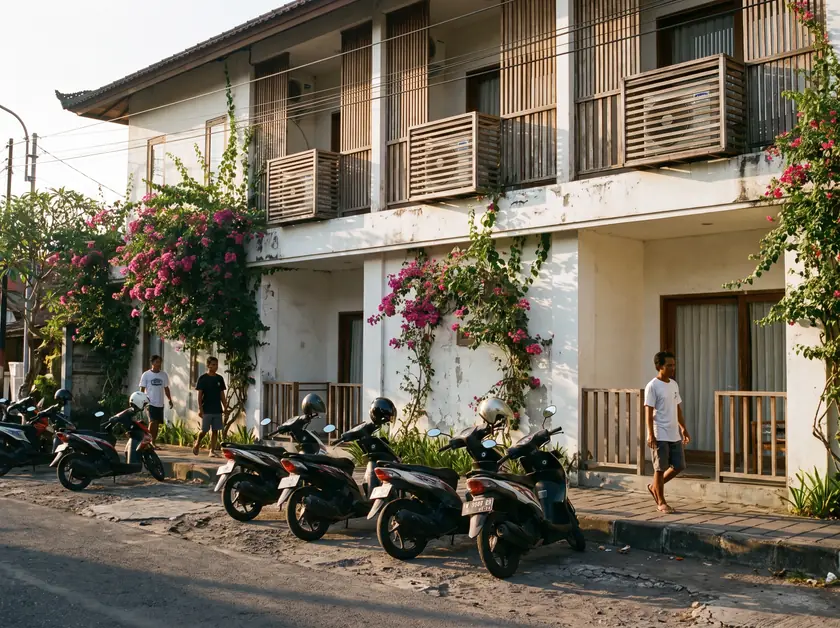
On splits, every room adds an outdoor unit on a balcony, a bracket or a screened niche. Behind tight timber screens the units often breathe their own hot exhaust, and capacity drops on the hottest afternoons, when it is needed most. Rooms at the back of the building need long pipe runs to the facade.
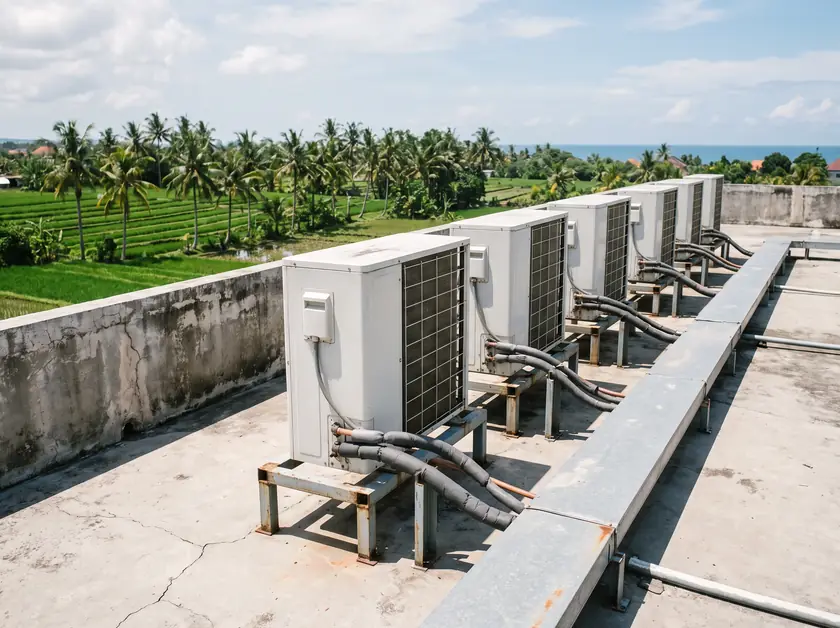
VRF groups the outdoor units on the roof or in a service yard, with pipes rising through a shaft. That frees balconies and facades, but it needs a roof that can carry the units, clear space around them for airflow and service, and a riser planned from the first design. Near the sea, outdoor coils and casings need corrosion protection whatever the system.
Noise in the room
Guests judge the system at night, from the bed. Compare indoor units by the sound level stated at low and medium fan speed, measured the same way, not only by capacity. A ducted unit above the bathroom ceiling can be quieter at the bed than a wall unit over the headboard, if its ducts and grilles are sized for low air velocity. Outdoor units count too: a split outside one balcony sits under the next room's window. Indonesia's building regulation asks for noise and vibration calculations in the design (PP 16/2021, article 187) and lets the SLF inspection measure both with instruments (article 226).
Part-load efficiency: where VRF earns its price
A hotel room spends most of its hours at part load: guests out during the day, curtains drawn, cooler nights. What matters is efficiency across that range, not only at the rated full-load point. Inverter splits modulate room by room; VRF modulates across the building and does best where many rooms run partly loaded together. Ask suppliers for seasonal efficiency figures measured under the same standard.
At the PLN B-2 business tariff of Rp 1,444.70 per kWh (July to September 2026), every kilowatt of average electrical demand that runs around the clock costs about Rp 12.7 million a year. The pressure is regional too: the IEA projects that air conditioners in Southeast Asia could grow from 40 million units in 2017 to 300 million in 2040, half of them in Indonesia, and that cooling could be responsible for as much as 30 % of the region's peak electricity demand.
Send the floor plans and the number of units. We compare the options on indicative capex, running cost and where the equipment and pipes go.
Fresh air: none of these systems brings it
Splits, ducted units, VRF indoor units and fan coils cool and dry the air already in the room. Close the balcony door and the room slowly fills with the moisture and carbon dioxide of the people in it. Indonesian building regulation requires ventilation that brings in fresh air and removes humidity and odours, and mechanical ventilation where natural ventilation cannot do the job (PP 16/2021, article 36).
In Bali, outdoor air is warm and wet all year, so fresh air is usually the largest moisture load in a room. Two common answers: an energy-recovery unit per room or per floor, which passes incoming air by the outgoing air first, or a central unit that cools and dries fresh air before it reaches the rooms. Both need duct routes planned with the ceilings: see heat-recovery ventilation and humidity and mould.
Pipes, condensate and insulation
- Pipe length and height. Every split and VRF range limits pipe length and the height between outdoor and indoor units. We check them against the building section at design stage, not on site.
- Tightness. A VRF circuit has many brazed joints. Brazing under nitrogen, a pressure test and a deep vacuum are recorded before the insulation closes, because one leak affects every room on the system.
- Refrigerant in small rooms. A large VRF charge and a small bedroom call for a check against refrigerant safety standards such as ISO 5149; the answer can be leak detection or smaller systems.
- Condensate. Every indoor unit makes water all day in Bali. Drains need fall, traps and a route into the building drainage, never a hose onto a balcony.
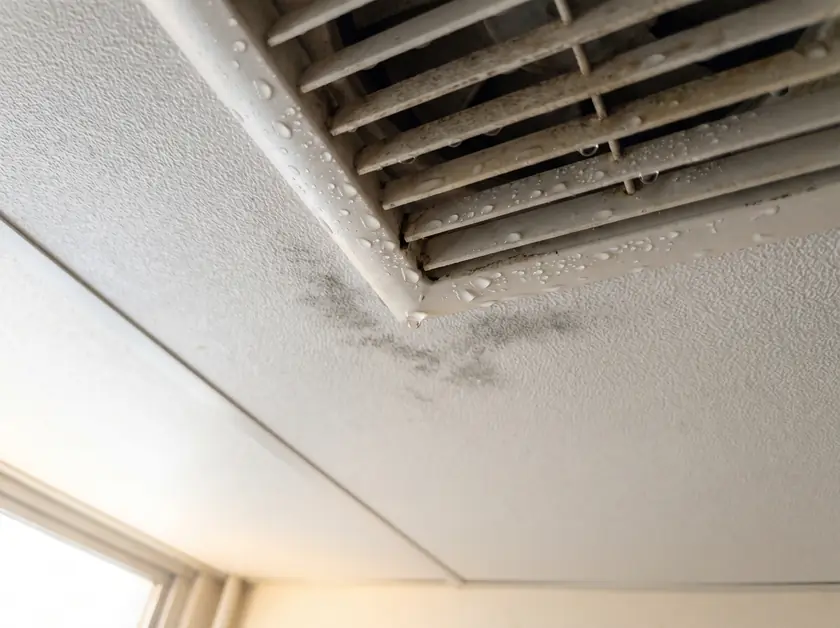
- Insulation. Cold refrigerant pipes and condensate lines run below the dew point of Bali air all year, so insulation must be continuous with a sealed vapour barrier. Every gap drips; see condensation on ducts and ceilings.
When something fails, and who fixes it
A failed split leaves one room warm. A failed VRF outdoor unit warms every room on that system, so larger buildings are divided into several systems by floor or wing. Chilled water concentrates the risk further unless the plant has standby chillers and pumps.
Service follows the same pattern: splits suit any trained technician, VRF needs brand-trained people, diagnostic software and spare parts on the island, chilled water needs a technical team. Choose the system your operator can actually run and put it on a maintenance plan from the first day; for a hotel our indicative planned-maintenance range is Rp 5-20 million per month, depending on the equipment.
Decision table: the usual fit by building
| Building | Units | Usual fit | Why |
|---|---|---|---|
| Guesthouse or villa units with private terraces | A handful | Wall or ducted splits, fresh air per unit | Lowest capex, simple service, outdoor units easy to hide |
| Low-rise apart-hotel with screened service balconies | A dozen or two | Ducted splits with screened outdoor units, or small VRF systems | Quiet rooms at moderate cost; check airflow behind the screens |
| Apart-hotel on several floors, tight facade, usable roof | Several dozen | VRF divided into systems per floor or wing, central fresh air | Clear facade, part-load efficiency, a fault stays in one zone |
| Hotel or resort with a plant room and technical staff | Large hotel scale | Chilled water or several VRF systems, central fresh-air units | Central control and standby, if the team can run it |
| Restaurant, bar or gym in the same building | Any | A system separate from the rooms | Different hours and loads; kitchens add exhaust and make-up air |
A starting point for the brief; the room-by-room load calculation decides.
How we approach it
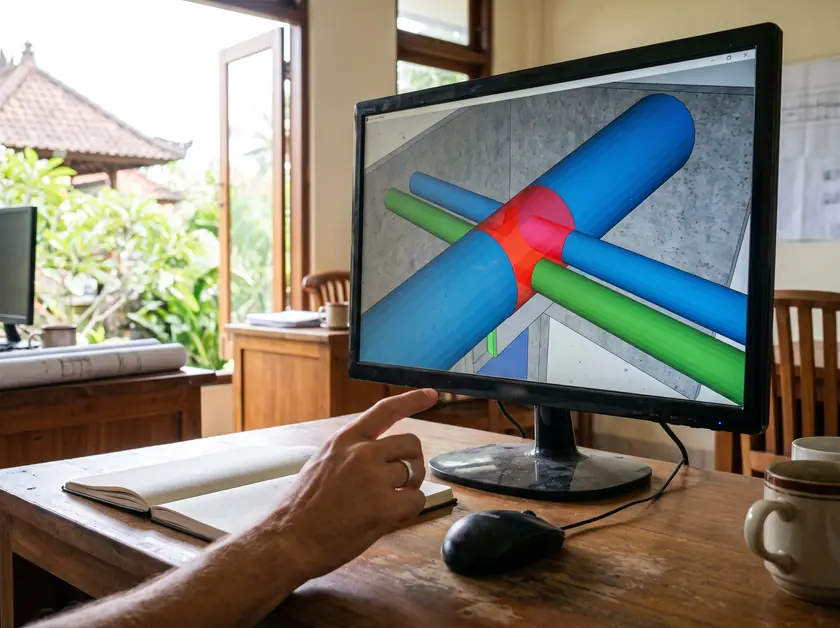
We start from a room-by-room load calculation, compare two or three options on capex, running cost, space and service, and draw the chosen system in the same model as the rest of the building. Whoever designs it, ask for loads and fresh air calculated to a named standard, such as SNI 03-6572-2001, the Indonesian design procedure for ventilation and air conditioning. At Anta Residence Canggu our scope covered MEP consulting, ventilation, air conditioning, water supply and water treatment. More on the service: ventilation and air conditioning.