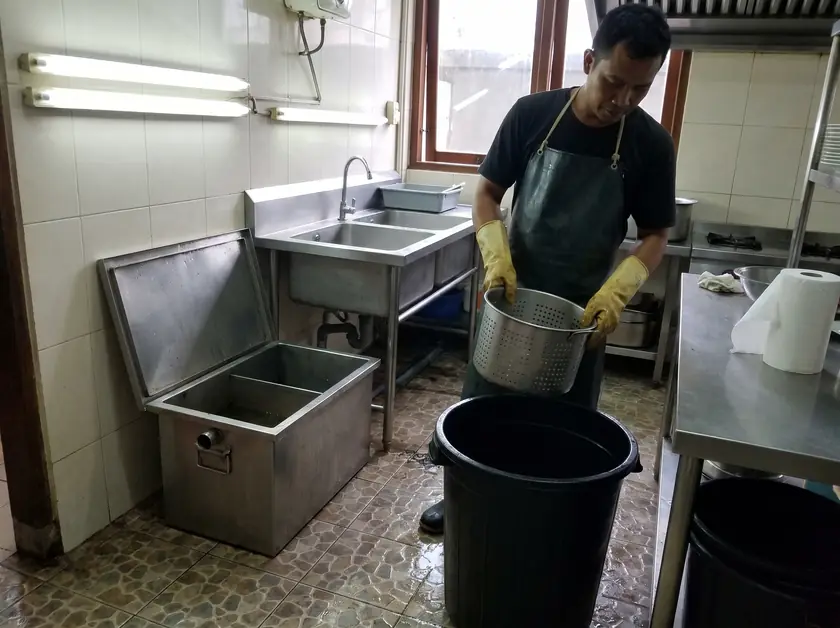
A grease trap is a stainless box with no moving parts, and it can still stop a kitchen in the middle of service. Too small, and fat passes straight through and sets in the drain further down. Out of reach, and nobody cleans it until the floor drain overflows on a busy Friday night. Both are decided at design stage, long before opening day.
How it works: fast, hot water in, slow, cool water out
Fat, oil and grease are lighter than water. In still water they float to the top while food solids sink to the bottom. A grease trap is a box that makes the water still: it enters behind a baffle, the grease collects at the surface, the sludge settles, and the water leaves from below the grease layer.
Three conditions decide whether that happens. Time: the water must stay long enough to separate, which is why the volume follows the flow. Temperature: warm fat stays liquid and mixed; Putra Kitchen, a Bali kitchen fabricator, notes that traps catch grease best below 60 °C. Turbulence: a full sink emptied in one go stirs the box and pushes grease out of the outlet.
California's Orange County Sanitation District lists the same three, plus enough storage volume between cleanings.
Size it from water flow, not from floor area
Hydromechanical interceptors, the stainless boxes under or beside the sink, are rated by flow: the City of Portland gives 20 to 50 US gallons per minute, about 75 to 190 litres per minute. Gravity interceptors are large tanks, usually buried in a service yard and sized by volume: 1,000 to 4,000 gallons, about 3.8 to 15 cubic metres. In the US the small units are tested and rated for flow under the PDI G-101 procedure, and districts such as Orange County size interceptors to the Uniform Plumbing Code.
The stainless boxes sold for Bali kitchens are of the first type, and the local market sizes them with its own rule of thumb. Putra Kitchen's 2026 guide counts 15 to 25 litres per minute for each sink and 30 to 60 for a commercial dishwasher, adds up everything that drains into the trap, allows one minute of retention and adds 20% for the peak. Two sinks at 20 litres per minute need about 48 litres, so a 50 to 80 litre trap. Add a dishwasher and the same café needs roughly twice the volume.
The same guide converts this into portions per day. Treat the table as a cross-check for a first meeting, not as a design method:
| Kitchen (Bali market guide) | Wash points | Trap volume | SS304 unit price | Installation |
|---|---|---|---|---|
| Café, 30-50 portions a day | 1-2 sinks | 50-80 L | Rp 1.5-2.5 million | Rp 300-500 thousand |
| Restaurant, 100-150 portions | 2-3 sinks | 100-150 L | Rp 2.5-4 million | Rp 0.5-1 million |
| Large restaurant, 200-400 portions | 4-6 sinks | 200-350 L | Rp 4-7 million (200-300 L) | Rp 1-2 million |
| Hotel or catering, 500+ portions | 6+ sinks and a dishwasher | 400-1,000 L | Rp 7-12 million (400-500 L) | Rp 1.5-3 million |
Sizes and prices: Putra Kitchen, Panduan Grease Trap Restoran, Bali, 2026 (a market guide, not a code). Indicative: a stainless 50-300 L trap with installation comes to about Rp 1.8-9 million; plastic HDPE units of 50-150 L cost Rp 0.8-2 million plus installation. See pricing.
A dishwasher can outweigh the sinks: the guide warns that a café with one commercial dishwasher may need a bigger trap than a restaurant with three ordinary sinks. A fried and grilled menu also sends more fat per litre than a steamed and baked one, so the same trap fills faster.
What drains into the trap, and what should not
- In: pot, prep and pre-rinse sinks, wok stations with water, and floor drains in the cooking area.
- The dishwasher: decide it on the drawing. Hot water with detergent carries emulsified grease through a small trap. Orange County requires dishwashers to bypass the interceptor; where one must drain through the trap, size the trap for its flow and give the water distance to cool.
- Out: food waste disposers. Ground food fills the trap with sludge. The New Orleans sewerage board tells restaurants to avoid the disposal and scrape plates into the bin.
- Out: toilets, hand basins and rainwater. They add flow and nothing to separate; Orange County keeps bathroom fixtures off the interceptor.
- Out: boiling water and used frying oil. Let pasta and stock water cool first, and collect frying oil in drums for recycling, never in a sink.
Send a photo of the trap, a list of what drains into it and how often it is emptied. Often the fix is size, position or a separate line for the dishwasher, not a new kitchen.
Placement: close to the sinks, easy to open
A trap that is hard to open does not get opened. Putra Kitchen names the most common installation error in Bali as a trap placed too far from the sinks: the longer the pipe, the more fat sets inside it before it arrives. The opposite error is a box under a counter full of fixed equipment, where lifting the lid means stopping the line.
- Within 1 to 2 metres of the farthest sink, as the Bali guide recommends.
- Outside the cooking line and away from prep and guest areas, because an open trap smells and cleaning should not stop service.
- At least 60 cm of free space beside the box, and no fridge or fixed counter on the lid.
- Inlet at least 5 cm above the outlet, and pipes laid at a 1 to 2% slope.
- A gasketed lid that keeps the smell and the pests inside.
- For large kitchens, a two-chamber interceptor in the service yard with covers over the inlet and the outlet; Orange County gives about two thirds of the volume to the inlet chamber.
When to clean: 25% of the depth and a log
US sanitation districts use a simple trigger. Orange County requires a full pump-out before floating grease and settled solids together exceed 25% of the design liquid depth, because beyond that the retention time is too short to hold grease back. New Orleans adds a minimum of every three months, whichever comes first, and Portland applies the same 25% to most interceptors.
Measuring takes a clear sampling tube or a marked rod. Read the grease layer on top and the sludge at the bottom, add them and divide by the water depth: in a trap with 40 cm of water, clean before the two layers reach 10 cm together.
Small under-sink boxes reach that line in weeks, not months. Putra Kitchen's schedule for Bali is every 6 to 8 weeks for a small café, 3 to 4 weeks for a medium restaurant and 1 to 2 weeks for a large restaurant or hotel. Start there, measure at every visit for the first month and move the interval to what the readings show.
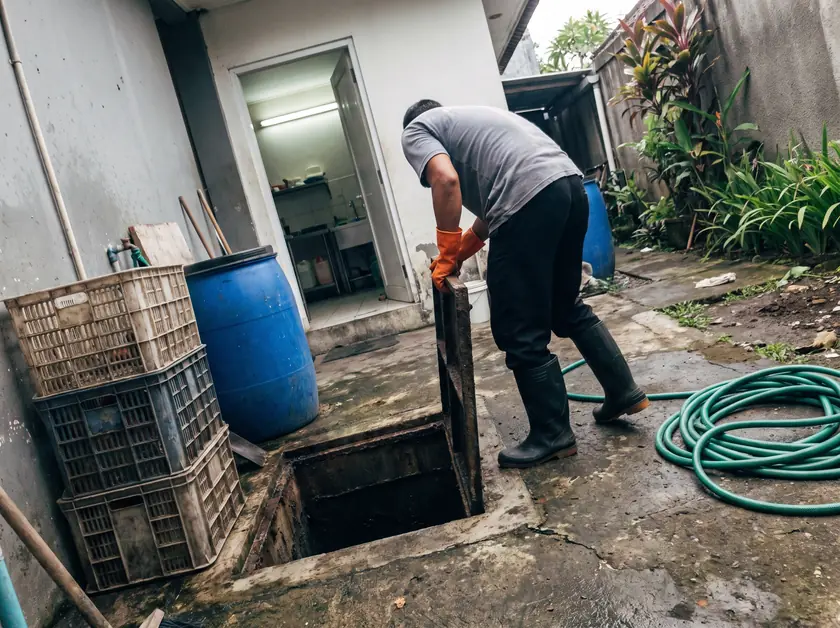
Clean the whole box, not just the surface: Orange County does not accept skimming alone. Scoop the grease cap into a closed container, remove the sludge, scrape the walls and baffles, check the gasket, and send the waste away with solid waste or a collector, never back into a drain.
Then log it: date, who cleaned, grease and sludge depth before cleaning, volume removed, where it went, baffle condition and the next due date. Orange County and New Orleans expect such records on site; for you, the log shows whether the interval is right.
What happens when nobody cleans it
A full trap stops separating. Grease leaves with the water, cools in the pipe and narrows it until the floor drain backs up during service; Portland warns of private line blockages, back-ups, foul odours and lost business. Further down the line, grease blockages are among the leading causes of sewage overflows in Orange County's region, and its ordinance links those overflows to risks for public health, aquatic life and the recreational use of waters.
Depending on the site, a Bali kitchen drains to a septic tank, a small treatment plant or the public sewer, and grease harms all three. Bacteria and enzyme dosing does not replace cleaning; Portland bans such additives because they let grease pass the interceptor and set again further down the sewer.
Owner's checklist
- Trap sized from the fixtures that drain into it, with the dishwasher decision on the drawing.
- No food waste disposer upstream, and a strainer in every sink.
- Lid free to open, 60 cm of working space, no equipment on top.
- Staff scrape plates and wipe greasy pans before washing.
- Cleaning interval set from measured depth, not from habit.
- Log and the collector's receipts kept on site.
We design grease traps as part of the kitchen drainage, with falls and access checked in the same Revit model as the ducts, and the trap can go into the maintenance plan so the log is kept for you. The hood side of the same kitchen has its own timetable in our note on exhaust cleaning, and the full pre-opening list is in the restaurant engineering checklist.
- Putra Kitchen: Panduan Grease Trap Restoran, ukuran, harga dan perawatan, Bali, 2026
- Orange County Sanitation District: Ordinance OCSD-25, Fats, Oils and Grease Control Regulations
- Orange County Sanitation District: Grease Interceptors and Basic Design Guidelines, fact sheet, 2026
- City of Portland, Bureau of Environmental Services: Grease interceptors
- Sewerage and Water Board of New Orleans: Grease Traps 101