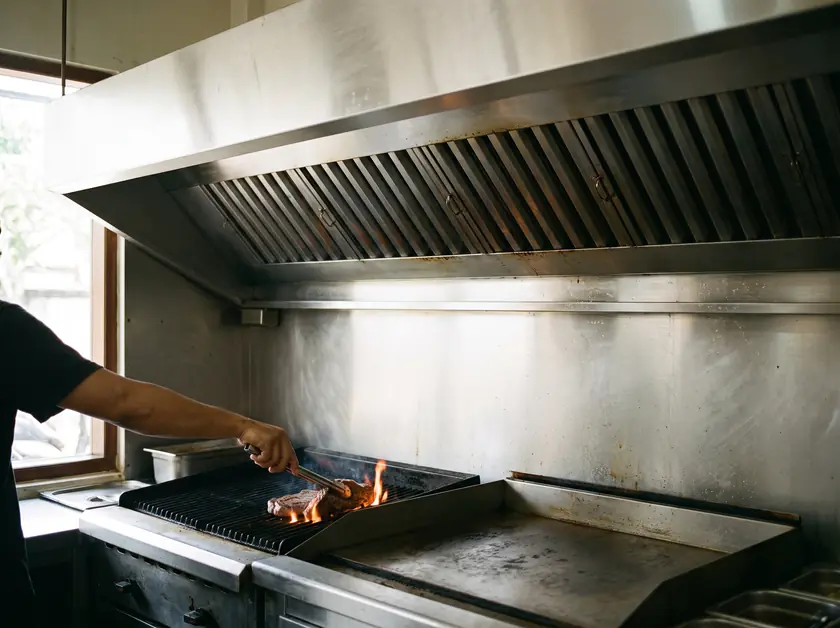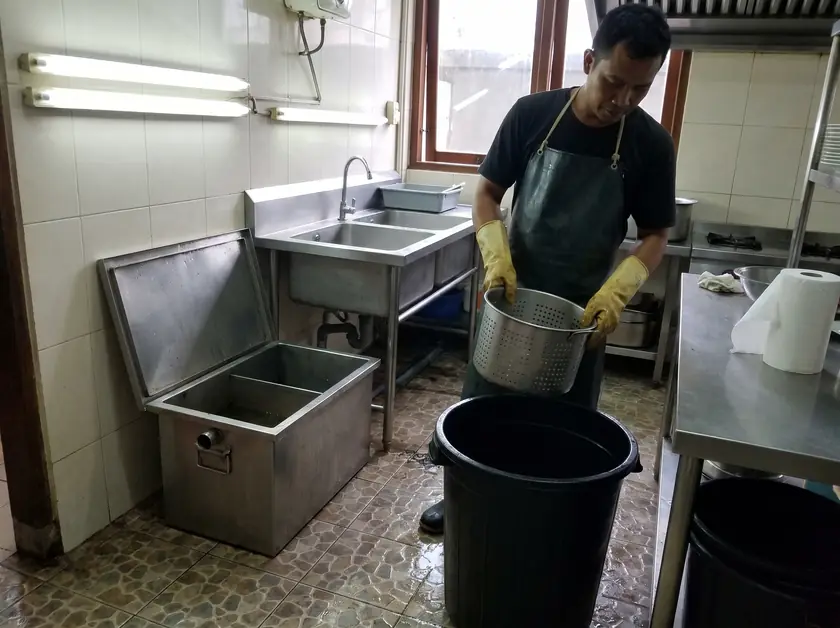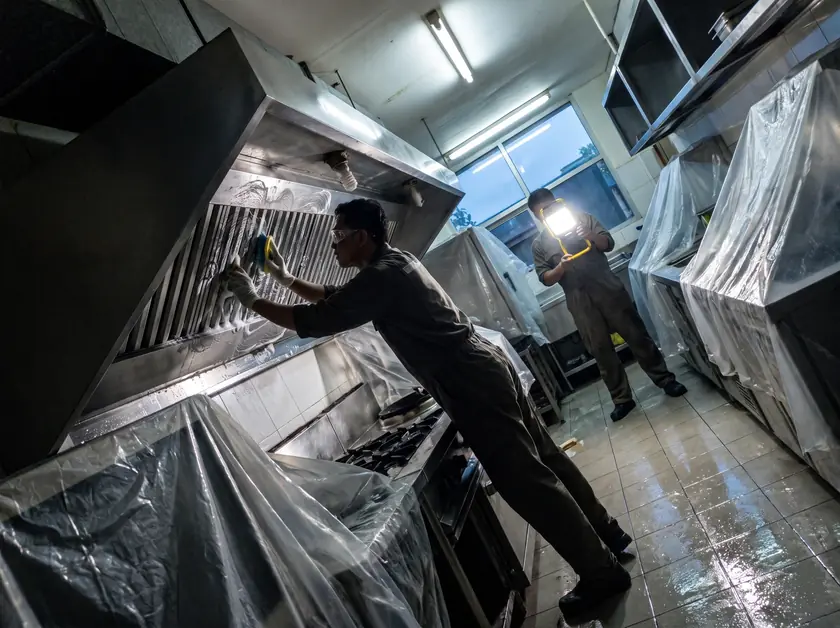
Every hood pulls grease-laden vapour, and part of the grease never reaches the filters. It condenses in the hood plenum, on the duct walls and on the fan wheel, a little each service, until the duct is lined with fuel and the fan moves less air. A cleaning schedule removes that grease before a flare-up at the grill finds it.
Why grease in the duct is a fire and airflow problem
NFPA data for the United States shows where restaurant fires start. In 2010 to 2014, fire departments attended an average of 7,410 structure fires a year in eating and drinking establishments: cooking equipment was involved in 61%, 59% began in the kitchen or cooking area, and failure to clean was a contributing factor in 22%.
The incident summaries in the same report repeat one pattern. Heat from a grill, rotisserie or fryer ignites grease in the hood or duct, and the fire runs along the duct into concealed spaces where extinguishers and hoses struggle to reach it. In one case the building was destroyed, and the owner told investigators the ductwork had been poorly cleaned two weeks earlier.
The same deposits cost airflow. Grease narrows the filters and the duct, the fan wheel gets heavier and out of balance, and the system moves less air than at commissioning. The first signs are smoke rolling out from under the hood at peak, a louder fan and a hotter kitchen.
The NFPA 96 schedule by cooking type
NFPA 96, the US standard for commercial cooking ventilation, sets how often the whole exhaust system must be inspected for grease. It is written for the US, but grease behaves the same way in Bali, so we use it as the starting point.
| Cooking operation | Examples in the standard | Bali kitchens that fit | Inspection |
|---|---|---|---|
| Solid fuel | Solid fuel cooking operations | Charcoal and satay grills, wood-fired pizza ovens, smokers | Monthly |
| High volume | 24-hour cooking, charbroiling, wok cooking | Steak and seafood grills, wok lines, 24-hour hotel kitchens | Quarterly |
| Moderate volume | No examples given | Restaurants with a mixed menu and normal hours | Every six months |
| Low volume | Churches, day camps, seasonal businesses, senior centres | Cafés that mostly heat and toast, seasonal kitchens | Annually |
NFPA 96 schedule of inspection for grease buildup: Table 11.4 in the 2017 edition, as quoted by the Village of New Paltz; Table 12.4 in the 2024 edition. The Bali column is our reading.
Two details matter. The table sets inspection intervals, and cleaning follows whenever an inspection finds grease deposits. The 2024 edition also gives a measurable trigger: a depth gauge comb is placed on the surface, and a deposit of 0.078 in (2,000 µm, that is 2 mm) on hood and duct surfaces, or 0.125 in (3,175 µm, about 3.2 mm) in a fan housing, means clean. Hoods with dampers, wash systems or other moving parts are also inspected and tested every six months, or as their maker specifies.
Filters by staff every day, ducts by a crew
Filters are the first line and the staff's job. They catch part of the grease before it reaches the duct, but only when they sit tight and are clean.
- After every service: empty grease cups and gutters, and wipe the hood edges and the inside of the canopy.
- Filters: wash them nightly over grills, woks and fryers; weekly can be enough over ovens and steamers. Soak them in hot water with degreaser, or use the dishwasher if the filter maker allows it.
- Never cook with filters out or with gaps between them; grease then goes straight into the duct.
- Report smoke spilling at peak, dripping grease, a burning smell or a fan that sounds different.
What staff cannot reach is the part that burns: the plenum behind the filters, the duct and the fan. That needs a crew, a night with the line off and the kitchen covered in plastic. The Village of New Paltz guidance lists the accepted methods after the International Kitchen Exhaust Cleaning Association: manual scraping, low-pressure detergent, high-pressure hot water and saturated steam, with every access panel restored afterwards.
Send photos of the hood, any access panel and the roof fan. We tell you which parts can be reached and what the first inspection should cover.
Access panels, the roof fan and grease on the roof
A duct can be cleaned only where someone can reach it. US codes, as summarised by New Paltz, ask for access panels wherever part of the hood or duct is out of reach, so that all of it can be cleaned, not just the first metre behind the filters. In practice that means grease-tight panels at changes of direction and along long runs, big enough for an arm and a scraper.
The roof fan is where neglected grease ends up. An upblast fan needs a grease drain to a container that someone empties, and a hinge or enough cable slack to tilt it for cleaning the wheel. Without them, grease spreads across the roof, attacks some waterproofing and washes into the gutters in the rainy season; a wheel caked on one side also shakes its bearings to failure.
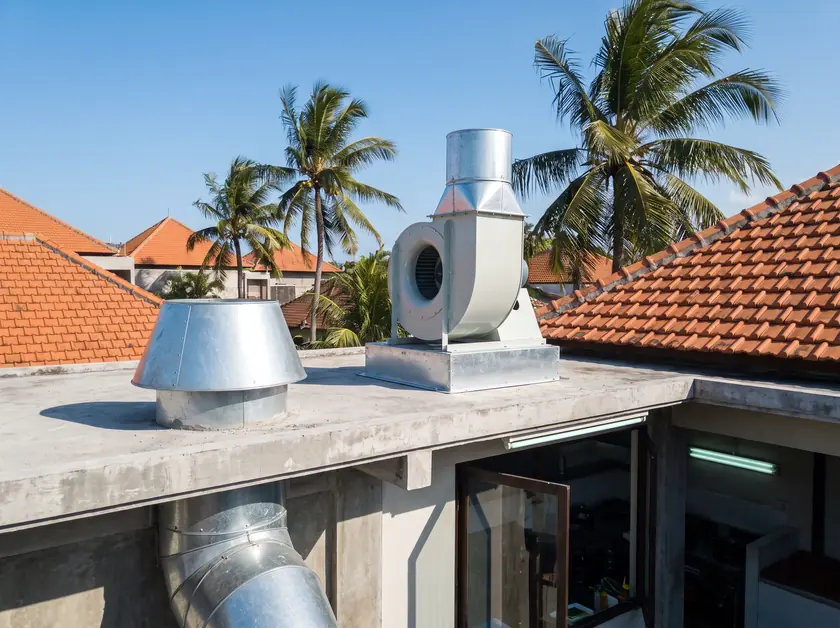
If your system has no panels, the first professional cleaning should include fitting them. A duct that cannot be opened cannot be cleaned, whatever the invoice says.
What a cleaning report must show
NFPA 96 requires a certificate kept on the premises with the name of the company, the person who did the work and the date. Ask for more than that:
- Before and after photos of each section from the same angle: hood plenum, every access panel, riser, fan housing and wheel.
- A sketch of the system with the access points numbered.
- Areas not reached and why (no panel, fire-rated shaft, seized fan hinge), with a proposal to fix the access.
- Grease depth before cleaning at fixed points, so the next interval rests on a measurement.
- Defects found: damaged filters, leaking seams, a worn belt, noisy bearings, a blocked grease drain.
- Confirmation that panels were closed, filters refitted and the fan restarted, plus a sticker on the hood with the next date.
What cleaning costs in Bali
Cleaning is priced by the hood, by the fan and by the square metre of duct, and vertical risers cost more per square metre than horizontal runs. Our indicative estimates per visit:
| Kitchen | Typical system | Per visit (estimate) |
|---|---|---|
| Small café | One hood, a short duct, one fan | Rp 1.5-4 million |
| Medium restaurant | One or two hoods, a longer duct with bends, a roof fan | Rp 3-9 million |
| Large or hotel kitchen | Several hoods, risers, more than one fan | Rp 8-20 million |
Estimates, IDR excl. VAT, built from published unit rates for hood, fan and duct cleaning (Global Ducting, Jakarta). Access, grease depth and night work move the figure; a survey confirms it. See pricing.
How a maintenance plan sets the schedule
- At commissioning we record the cooking type, fuel, hours and measured airflows, so a later drop shows up.
- The first interval comes from the NFPA 96 category of the heaviest cooking on the line.
- At each inspection the crew measures grease at the same points and photographs them.
- If deposits reached the trigger before the visit, the interval gets shorter; if the duct stays light, it stays as it is.
- Filter routines, fan belts, make-up air filters and the grease trap share one calendar, so one visit covers the kitchen.
That is how our maintenance plan works for kitchens we build and, after a first inspection, for systems installed by others. If smoke escapes even from a clean hood, the problem is capture, not grease: see our note on hood airflow.
- Village of New Paltz: Kitchen Hood Cleaning Requirements (summary of NFPA 96-2017)
- NFPA: NFPA 96 First Draft Report, First Revision No. 52 on grease depth, 2024
- NFPA Research, R. Campbell: Structure Fires in Eating and Drinking Establishments, 2017 (archived copy)
- Facilitec Southwest: Commercial kitchen exhaust cleaning frequency (NFPA 96-2024, Table 12.4)
- Global Ducting: kitchen hood, blower and duct cleaning rates, Jakarta