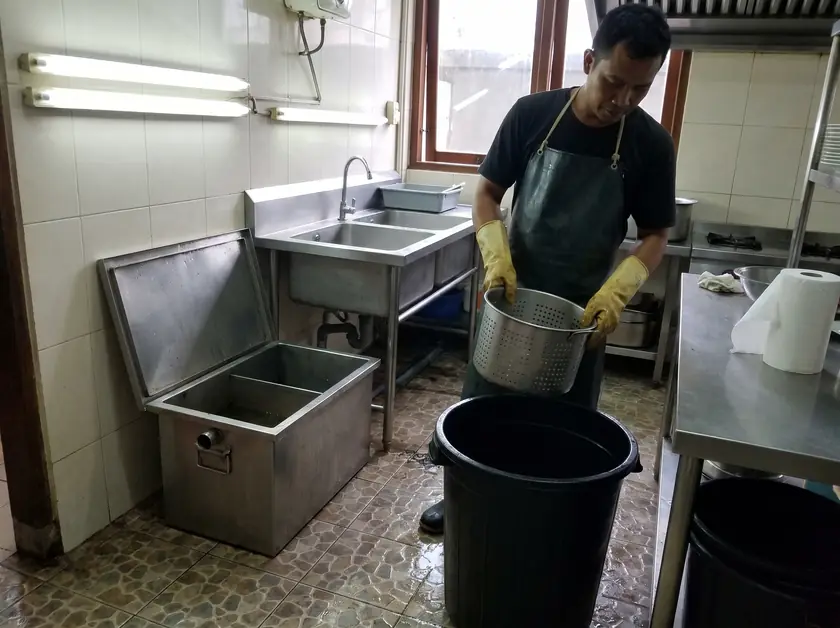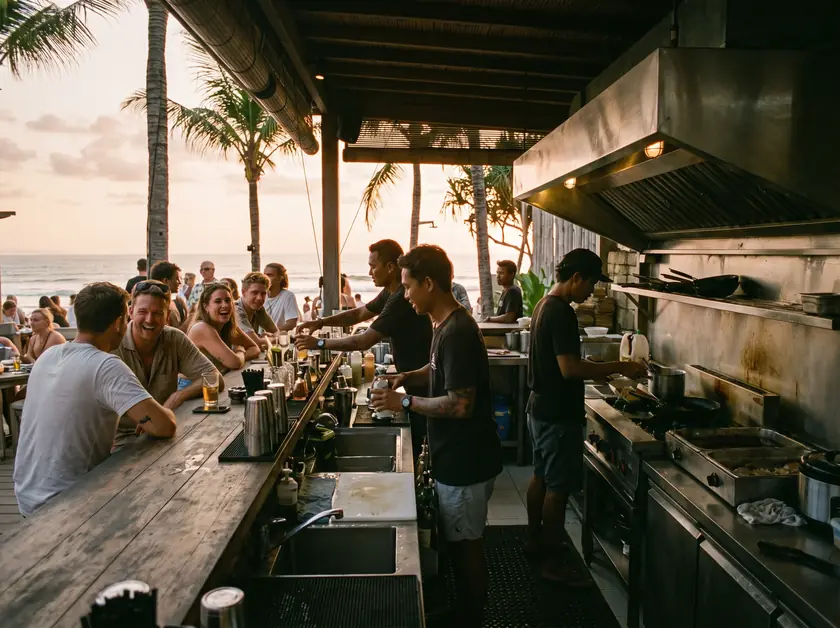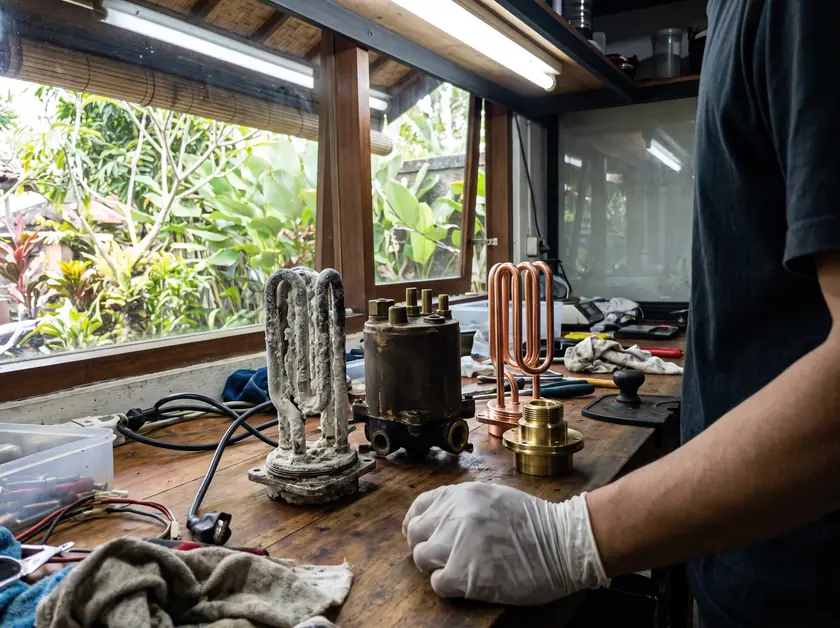
Most water problems in a commercial kitchen stay invisible until a machine stops. Scale grows inside the espresso boiler, on the steam generator of the combi oven, on the dishwasher heater and on the freezing plate of the ice machine. The treatment that protects one of them can be wrong for the next, which is why one filter for the whole kitchen rarely works.
Hardness, TDS and alkalinity in plain words
Hardness is the dissolved calcium and magnesium, the minerals that form scale when water is heated. The US Geological Survey calls water soft up to 60 mg/L (as calcium carbonate), moderately hard from 61 to 120, hard from 121 to 180 and very hard above that.
Alkalinity is the water's buffer, mostly bicarbonate. It matters twice: the hardness paired with bicarbonate (carbonate hardness) is what drops out as scale in a boiler, and in coffee it neutralises acids, so high alkalinity gives flat, dull cups and very low alkalinity gives sharp ones.
TDS, total dissolved solids, is everything dissolved in the water. Meters estimate it from conductivity, so it tells you how much is in the water but not what. Two waters with the same TDS can behave very differently in a boiler, which is why a TDS reading alone never decides the treatment.
How scale damages the kitchen's hot and cold machines
The USGS describes the mechanism: when hard water is heated, calcium carbonate deposits form, shortening equipment life and raising the cost of heating. In a kitchen the damage shows up in four places.
- Espresso machine: scale lines the boiler and the element, narrows pipes and jets, and insulates the element until it overheats. Temperature drifts, shots change, and the machine goes for descaling.
- Combi oven or steamer: the steam generator boils water off and leaves the minerals behind, so it scales faster than anything else in the kitchen. Weaker steam comes first, a failed heater later.
- Dishwasher and glasswasher: scale on heaters and rinse nozzles, white spots on glasses, more detergent for the same result.
- Ice machine: scale on the freezing plate slows the ice release; cloudy ice and more frequent cleaning follow.
Coffee: the SCA water target
Coffee is the one line where the aim is not simply fewer minerals. The Specialty Coffee Association of America published brewing water standards with a target and an acceptable range for each parameter:
| Parameter | Target | Acceptable range |
|---|---|---|
| Calcium hardness | 68 mg/L | 17-85 mg/L |
| Total alkalinity | 40 mg/L | at or near 40 mg/L |
| TDS | 150 mg/L | 75-250 mg/L |
| pH | 7.0 | 6.5-7.5 |
| Sodium | 10 mg/L | at or near 10 mg/L |
| Total chlorine | 0 mg/L | none |
| Odour and colour | clean, clear | odour free |
SCAA Statistics and Standards Committee, Water Standards (archived page). Hardness appears there as 4 grains, range 1 to 5 grains.
Read it as a window. With too little mineral and buffer, coffee tastes sharp and hollow; with too much, scale builds in the machine and alkalinity flattens the cup. That is why an espresso line usually gets filtration with partial softening: the cartridge takes out part of the carbonate hardness, a bypass blends some untreated water back in, and activated carbon removes chlorine and odours. The bypass is set from a hardness test, not left at the factory setting.
Too soft is also a fault. A standard softener swaps calcium and magnesium for sodium, so hardness drops to near zero while sodium rises away from the SCA target of about 10 mg/L. Reverse osmosis strips almost everything; that water tastes flat and is aggressive to metals, so RO for coffee always needs remineralisation. Zero hardness suits a steam generator, not an espresso machine.
Combi ovens, dishwashers and ice machines
Combi oven makers publish water requirements in the installation manual, usually limits for hardness and for chlorides, because chloride attacks stainless steel at steam temperatures. Some ovens descale their own steam generator; others rely on softened or reverse osmosis water. Read the manual for your model before choosing the treatment, and keep the water test in the equipment file.
Dishwashers are the simple case: a softener sized for the incoming hardness protects the heater and saves detergent. Ice machines need fine filtration against sediment and a scale inhibitor; where TDS is high or the bar wants perfectly clear ice, a small RO unit feeds them.
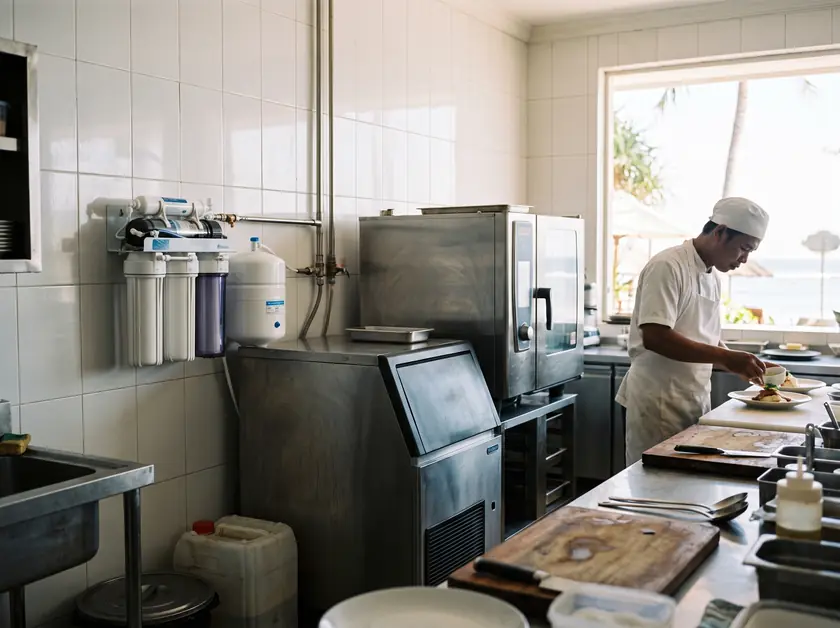
List the coffee machine, combi oven, dishwasher and ice machine models and add a photo of the water inlet. We tell you which lines need treatment, what to test and what it costs to run.
Test first: Bali water is not one water
A venue in Bali may run on PDAM mains, its own well, trucked water or a mix, and each source brings its own hardness, TDS and iron. A filter chosen on a neighbour's advice is a guess. Test at the point of use of each line, and again whenever the source changes, for example when the well takes over from PDAM.
- Total and carbonate hardness, with a drop test or strips.
- Alkalinity and pH.
- TDS, with a calibrated meter.
- Free and total chlorine, which carbon must remove before coffee and ice.
- Chloride and iron from a laboratory, when a combi oven or a well is involved.
One treatment per line
| Line | Typical treatment | Check on each visit | Indicative price |
|---|---|---|---|
| Espresso machine | Partial softening cartridge with carbon, bypass set from the test | Hardness after the filter, litres used | Rp 3.35-4.5 million per filter set |
| Combi oven, steamer | Softening or RO to the maker's limits | Hardness, chloride, drain for regeneration or reject water | Rp 5-15 million (estimate); RO from Rp 25 million |
| Dishwasher, glasswasher | Softener sized for hardness and volume | Output hardness, salt level | Within Rp 5-15 million (estimate) |
| Ice machine | Fine filtration with scale inhibitor; RO where TDS is high | Filter pressure drop, ice clarity | RO Rp 25-150 million |
Indicative, IDR excl. VAT: coffee filter set from a 2026 Indonesian retail listing; softening and filtration is our estimate; commercial RO for 200 to 2,000 US gallons a day from TokoAir, 2026. See pricing.
For scale: a 200 gallon-per-day RO unit makes about 760 litres a day, the size a supplier recommends for restaurants and cafés, and it sends part of the incoming water to drain as reject. It is a plant item with pre-filters and a membrane to look after, not a cartridge.
Cartridges, resin and membranes need a schedule
Treatment works only while it has capacity left. A coffee cartridge is rated in litres at a given carbonate hardness: one model sold in Indonesia is listed at about 2,400 litres at 10 °dH (about 178 mg/L as calcium carbonate) with a 40% bypass. Harder water or a busier bar uses it up sooner, so the change date comes from the water test and the daily volume.
- A flow meter on each treated line, read at every visit.
- Cartridges changed at their rated litres or at the maker's time limit, whichever comes first.
- Softener salt topped up and output hardness checked with a strip.
- RO pre-filters and carbon changed on time; the membrane checked by TDS in and out.
- Bypass and service valves, so a change takes minutes and the bar keeps working.
- Each change logged with the date, meter reading and test result.
We design treatment as part of the kitchen plumbing: space for the units, a drain for regeneration or reject water, and valves for service. The options are on our water treatment page, cartridge changes can go into the maintenance plan, and the rest of the pre-opening list is in the restaurant engineering checklist. At Anta Residence Canggu our scope included water treatment together with MEP consulting, ventilation, air conditioning and water supply.